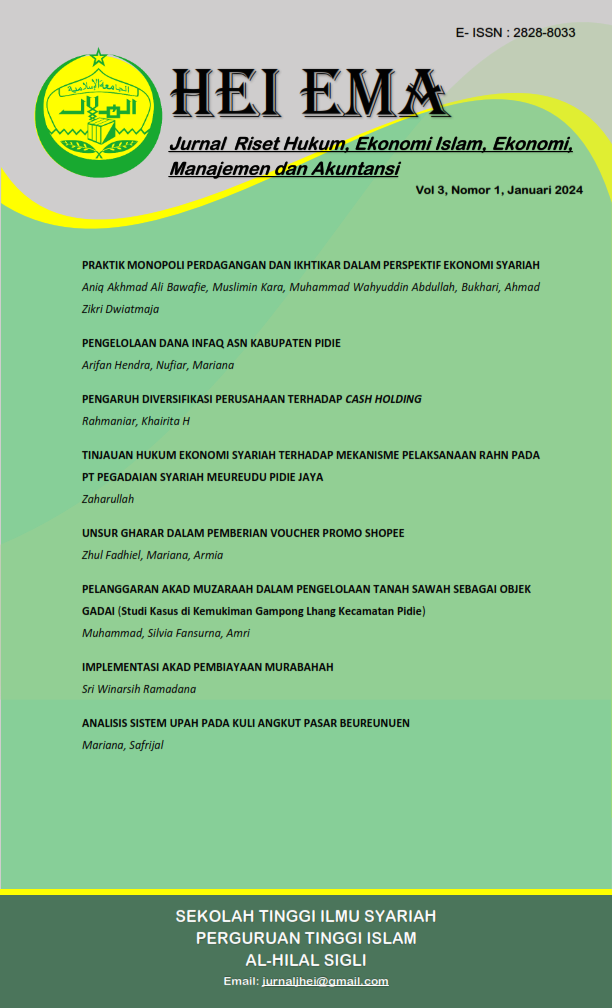
THE EFFECT OF FINANCING RISK AND LIQUIDITY ON THE PROFITABILITY OF ISLAMIC COMMERCIAL BANKS
DOI:
https://doi.org/10.61393/heiema.v3i1.557Keywords:
Profitability, Islamic Banks, NPF, CAR, FDRAbstract
This study aims to investigate how Indonesian Islamic commercial banks' profitability, measured by Return on Assets (ROA), is affected by Non-Performing Financing (NPF), Capital Adequacy Ratio (CAR), and Financing to Deposit Ratio (FDR). Panel data regression analysis was used as a quantitative approach in this study. Purposive sampling was used to choose the sample, which comprised Islamic commercial banks registered with the Financial Services Authority (OJK). Five Islamic commercial banks with a total of 80 observations throughout the 2021–2023 period were selected based on the specified criteria. Secondary data from Islamic Banking Statistics, quarterly financial statements, and other relevant literature was used. EViews software was used to analyze data using the Fixed Effect Model (FEM). The results show that the profitability of Indonesia's Islamic commercial banks is significantly impacted concurrently by NPF, CAR, and FDR. ROA is significantly impacted negatively by NPF and CAR and positively by FDR. The research model appears to adequately account for variations in the profitability of Islamic banks, as indicated by the Adjusted R-squared value of 96.7%. These findings imply that controlling financing risk, guaranteeing capital sufficiency, and monitoring liquidity are essential components for improving the financial performance of Indonesia's Islamic commercial banks.
References
Bank Indonesia. (2023). Indonesian Islamic Economic Report. Jakarta: Bank Indonesia.
Brigham, E. F., & Houston, J. F. (2018). Fundamentals of Financial Management (14th ed.). Cengage Learning.
Hasan, M. (2020). Risk management in Islamic banks. Global Finance Journal, 12(2), 45–57.
Hasan, M., & Dridi, J. (2019). The effects of the global crisis on Islamic banks and conventional banks. IMF Working Paper, 10(201), 1–30.
Karim, A. A. (2017). Islamic Banking: Fiqh and Financial Analysis. Jakarta: Raja Grafindo Persada.
Kasmir. (2019). Financial Statement Analysis. Jakarta: Raja Grafindo Persada.
Mariana. (2016). Pengaruh Return on Investment, Current Ratio, Debt to Equity Ratio terhadap Pengambilan Keputusan Kredit pada PT. Bank Rakyat Indonesia (Persero), Tbk Cabang Sigli Unit Meureudu dan PT. Bank Syariah Mandiri Office Meureudu. Jurnal Akuntansi dan Keuangan, 5(1), 85–90.
Mariana, M., Abdullah, S., & Mahmud, M. (2020). Corporate Governance Perception Index, Profitability and Firm Value in Indonesia. Technology and Investment, 11(2), 13–21.
Mariana, M., Nadirsyah, N., & Abdullah, S. (2018). Informasi Akuntansi, Informasi Non-Akuntansi, dan Keputusan Pemberian Kredit. Jurnal Reviu Akuntansi dan Keuangan, 8(2), 177–192.
Nugraha, A. (2020). Capital adequacy and bank profitability. International Journal of Finance, 8(1), 33–41.
Nufiar, N., Mariana, M., & Muhammad Ali. (2020). Settlement of Problematic Loans in the Unit Pengelola Kegiatan (UPK) of Pidie District did Sharia. Journal of Social Science, 1(4), 147–151.
Pratama, D. (2021). Non-performing financing and Islamic bank performance. Journal of Islamic Finance, 6(2), 55–63.
Rahman, M., Hasan, M., & Alam, M. (2019). Credit risk and bank profitability. Asian Economic Journal, 15(3), 112–124.
Ramadana, S. W., & Mariana, M. (2023). Chief Executive Officer, Financial Leverage dan Perusahaan Manufaktur yang Terdaftar di Bursa Efek Indonesia. HEI EMA: Jurnal Riset Hukum, Ekonomi Islam, Ekonomi, Manajemen dan Akuntansi, 2(1), 33–43.
Setiawan, B. (2020). Liquidity and financial performance. Finance Research Letters, 10(1), 21–28.
Wulandari, S. (2022). Determinants of Islamic bank profitability. Journal of Banking Studies, 7(1), 40–51.
Downloads
Published
How to Cite
Issue
Section
License
Copyright (c) 2026 Nurmila Dewi

This work is licensed under a Creative Commons Attribution 4.0 International License.